

Last month, I had the privilege of representing Pennant Technologies at the India AI Impact Summit 2026, held at Bharat Mandapam and inaugurated by our Hon’ble Prime Minister Narendra Modi.
Anchored around the principles of People, Planet, and Progress, the summit brought together global leaders, policymakers, researchers, and enterprises to explore one central question:
Across industries, one message came through clearly: the enterprise conversation around AI has matured.
Organisations are no longer focused on isolated pilots or experimental use cases. The focus has shifted toward scalable, governed, enterprise-ready AI platforms that can improve outcomes, reduce operational complexity, and deliver measurable business value.
For the banking and financial services industry, this shift is particularly significant, especially in the context of lending operations.
This broader shift toward impact-driven AI adoption was echoed during the summit’s opening remarks by Sundar Pichai, CEO of Google, who described AI as “the biggest platform shift of our lifetimes,” with the potential to drive breakthroughs across industries and improve billions of lives. His remarks reinforced the idea that organisations are moving beyond experimentation toward deploying AI in ways that generate tangible economic and operational outcomes.
As AI adoption moves from experimentation to enterprise implementation, financial institutions are asking more practical and operational questions:
These are no longer theoretical questions. They are core operational priorities for institutions looking to modernise lending infrastructure.
However, addressing these questions requires first understanding the structural challenges present in traditional lending operations.
Across the lending lifecycle, from origination to servicing to recovery, institutions often face several operational constraints:
While many institutions have implemented digital systems, these systems often remain process-driven rather than intelligence-driven.
This is where the next phase of AI innovation begins to reshape the lending landscape.
A key concept that emerged during the summit discussions was Agentic AI.
Agentic AI represents a shift from rule-based automation to intelligent orchestration.
Instead of simply automating predefined tasks, Agentic AI systems can facilitate:
This marks the evolution from workflow automation to enterprise AI orchestration.
The broader technology landscape is already moving in this direction. According to Gartner, at least 15% of day-to-day work decisions will be made autonomously through agentic AI by 2028, up from 0% in 2024. In addition, 33% of enterprise software applications are expected to include agentic AI capabilities by 2028, compared to less than 1% in 2024.
These projections highlight how quickly organisations are moving beyond experimentation toward embedding AI directly into enterprise workflows and decision systems.
For financial institutions, this evolution has meaningful implications across the lending lifecycle, from origination and underwriting to servicing and collections.
Within a Loan Origination System (LOS), AI can support multiple stages of the credit evaluation process.
Examples include:
Rather than replacing credit teams, AI augments their decision-making capabilities, enabling faster onboarding, improved decision consistency, and stronger coordination between sales, credit, and risk teams.
Once a loan is originated, however, the real operational complexity begins during servicing, which is where AI can further enhance lending infrastructure.
The Loan Management System (LMS) serves as the backbone of loan servicing operations.
When enhanced with AI capabilities, an LMS can evolve from a passive record-keeping system into an intelligence layer for portfolio monitoring.
AI-enabled LMS platforms can:
The result is not just automation but embedded operational intelligence within servicing workflows.
As servicing becomes more intelligent, the next area where AI delivers measurable value is collections and recovery.
Collections have traditionally operated in reactive cycles, with institutions responding to delinquency after it occurs.
AI introduces a far more predictive and proactive approach.
AI-driven collections can:
This enables institutions to transition from reactive collections management to coordinated, intelligence-led recovery operations.
One insight that stood out throughout the summit discussions was clear:
The future of AI in financial services lies beyond standalone models.
Instead, it lies in connected AI ecosystems, where systems reason, collaborate, and operate seamlessly across Loan Origination, Loan Management, and Collections platforms.
In other words, the industry is moving through a clear evolution:
Automation → Orchestration → True Agentic Lending Enterprises
What Resonated Most with Financial Institutions
Across multiple discussions with leaders from banking and financial services institutions, a few consistent priorities emerged.
Organisations are looking for AI initiatives that:
The conversation is no longer about whether to adopt AI.
It is about how to embed AI meaningfully within enterprise lending infrastructure.
The momentum around enterprise AI is unmistakable.
What stood out most at the India AI Impact Summit 2026 was not experimentation, but intent, intent to move toward scalable, governed, and measurable AI adoption.
For financial institutions, the opportunity lies in reimagining the lending lifecycle as an intelligence-led ecosystem, rather than a sequence of disconnected workflows.
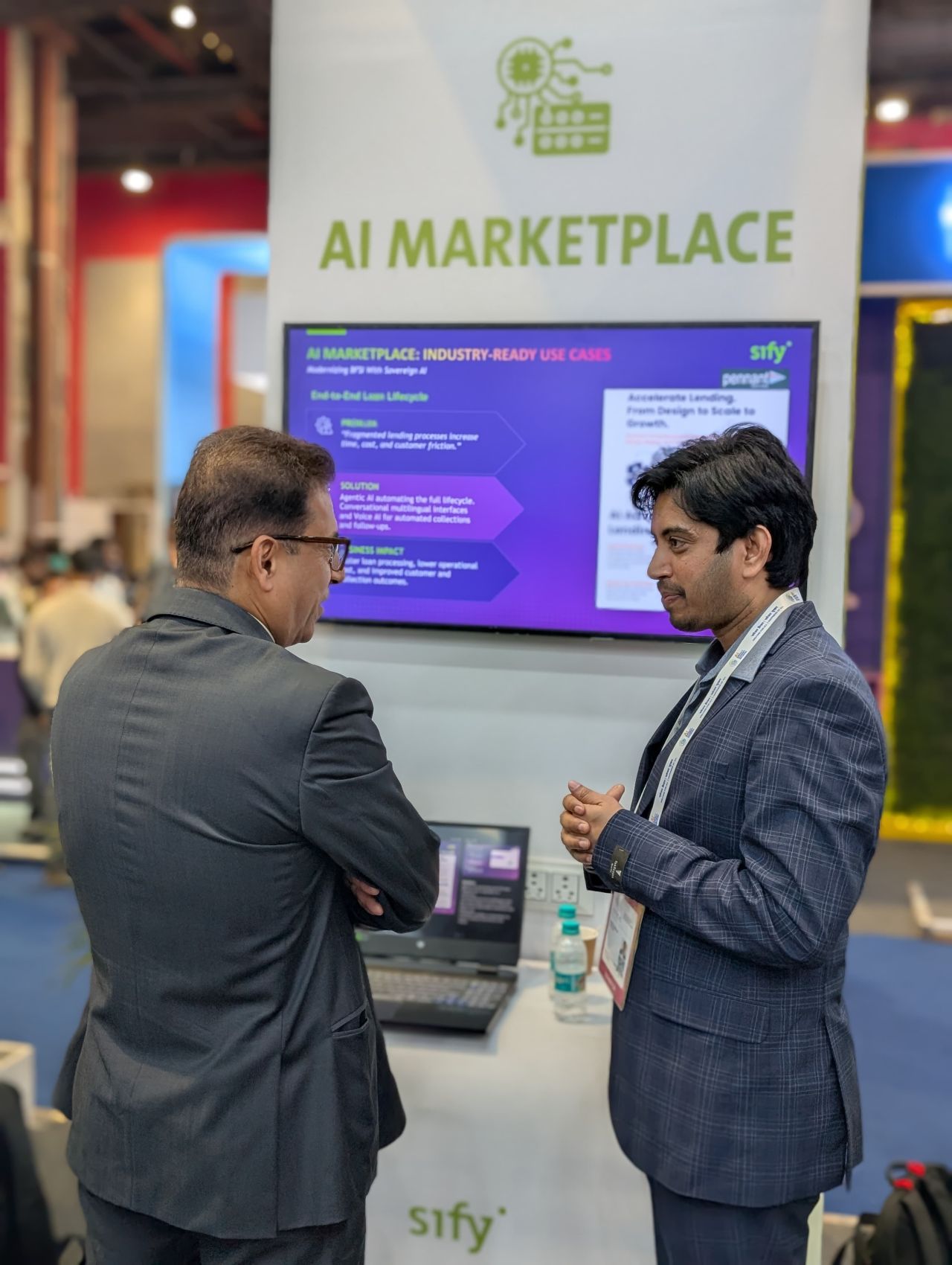
A special thanks to the team at Sify Technologies for facilitating meaningful discussions around the next phase of enterprise AI innovation.
The next chapter of AI in lending will not be defined by isolated tools, but by orchestrated systems designed to deliver measurable impact.
What does enterprise AI mean for financial institutions?
Enterprise AI refers to AI capabilities integrated across core platforms such as Loan Origination Systems and Loan Management Systems, enabling coordinated intelligence rather than isolated automation.
Is Agentic AI different from traditional automation?
Yes. Traditional automation executes predefined rules. Agentic AI systems interpret context, recommend actions, and collaborate with human users across multiple lending functions.
Can AI replace human decision-makers in credit and risk?
The goal is augmentation, not replacement. AI enhances analysis and workflow efficiency, while final decision authority remains with human experts.
Where does AI create the most impact in the lending lifecycle?
Impact is typically seen across origination efficiency, servicing intelligence, and collections optimisation, particularly when systems are connected rather than siloed.
Recent Blogs